
In technical documentation, everyone knows the topic-based method is a must. But what is it exactly?
In the topic-based method, every topic stands alone
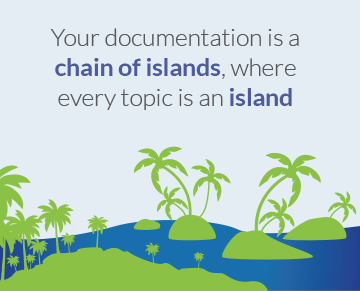
Every topic should be independent. This means that when you’re developing a topic, you have to thoroughly answer all questions (who, what, how, when, why). This way, every topic becomes complete in and of itself. When topics can stand alone, they can be switched around and used in different contexts without affecting the integrity of the whole document. Imagine your documentation as a chain of islands, where every topic is an island. The subject matter is independent, but fits into the group.
One need, one topic
To properly zoom in on content, the topic has to meet a need or answer a question the user is asking, such as “Where do I start?,” “What concepts do I need to know to understand the product?,” “How do I XYZ?,” “How can I solve this problem?,” etc. These answers will become your topics! Technically, a topic must fully answer a specific question so users find all the necessary information in one place.
Like every page is the first
As Mark Baker explains so well, in the topic-based method, “every page is page one.” Since every topic is self-sufficient, we don’t know in which order users will be consulting our topics. This is why we always have to put users into context. Sometimes, this means repeating elements from one topic to another. The key is saying enough to situate the users and to provide a complete and independent topic without, however, wandering from its purpose.
Spot-on titles
The title should precisely describe the subject being presented. Don’t forget: the title is the users’ main tool for finding the topics that are relevant to their questions. Coming up with the right title can be quite the challenge! It should be specific, but simple. It should summarize the topic, but also make it easy to find.
User freedom
With the topic-based method, users can seek out only the information they need, without having to sift through information that is not useful. Like tourists who visit a chain of islands and decide which ones to visit and in which order, users choose what they want to read and when.
To learn more…
Every page is page one